.png)
Mathematics
Discover how Dazhong Primary nurtures confident, self-directed Maths learners through hands-on experiences, structured problem-solving, and programmes that make Mathematics meaningful and enjoyable.
Mathematics
Vision:
To cultivate confident and reflective mathematical thinkers who apply reasoning with clarity, integrity and purpose in authentic contexts
Mission:
To develop self-directed learners with deep conceptual understandings, strong problem-solving competencies and positive mathematical dispositions through engaging, differentiated and data-informed pedagogies
Key Approaches:
The broad aims of Mathematics education in Dazhong are aligned to that of the National curriculum. They are to enable students to:
- acquire & apply mathematical concepts & skills;
- develop cognitive & metacognitive skills through a mathematical approach to problem solving; &
- develop positive attitudes towards Mathematics.
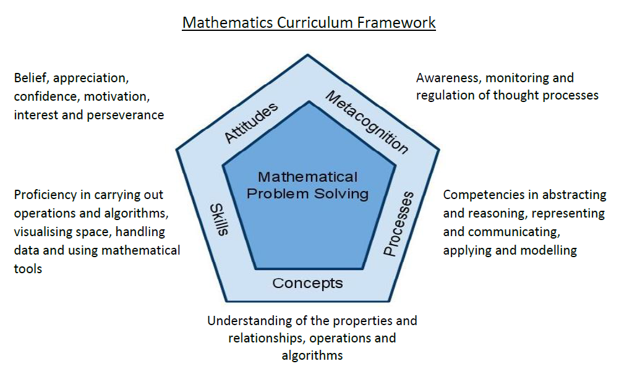
To develop our students to acquire and apply the necessary skills, concepts, processes, attitudes and metacognition towards learning Mathematics, the department carefully designs and plans suitable learning experiences (LEs) both in and out of the classroom. Such LEs help students to activate their learning and promote critical and inventive thinking. At suitable milestone checkpoints, we assess and monitor their learning.
Dazhong Mathematics lessons are thoughtfully designed to:
- Engage students in meaningful learning by developing their mathematical problem-solving competencies holistically through the Concrete–Pictorial–Abstract (CPA) approach.
- Excite students in the learning of Mathematics and nurture a love for the subject through authentic, engaging, and meaningful learning experiences.
- Empower students to become self-directed learners through timely feedback, differentiated instruction, and targeted support that caters to their diverse learning needs.
Our key pedagogical approaches include:
Concrete-Pictorial-Abstract Approach: The Concrete-Pictorial-Abstract (C-P-A) Approach engages our students in the process of deep and active learning and the mastery of mathematical concepts and skills in our classrooms. Students participate in activities involving the use of concrete materials and pictorial representations or diagrams to acquire full conceptual understanding in Mathematics.
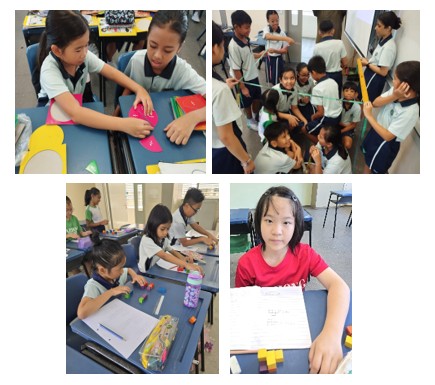
Authentic learning experiences: In line with our Mathematics Department’s approach of promoting the love for Mathematics learning through authentic learning experiences and our belief that our students learn best through purposeful play, we provide a wide range of learning experiences for students in our Mathematics classrooms. For instance, when teaching the topic of ‘Angles’ to middle-primary students, we provide our students with opportunities to find angles in the environment and use a ‘paper right angle’ to identify right angles, obtuse angles and acute angles.
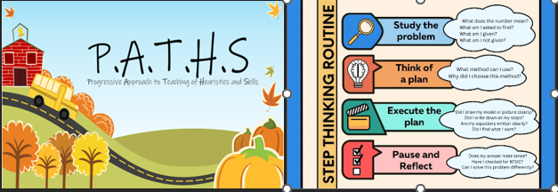
George Polya’s 4-Step Approach to Problem Solving: The S.T.E.P Thinking Routine was adopted from George Polya’s four-step approach for problem solving. It was intentionally created to scaffold our students’ critical and problem solving skills when tackling heuristics and problem sums. Students will make use of the four steps in the S.T.E.P Thinking Routine when solving Mathematics problems – Study the problem, Think of a plan, Execute the plan, Pause and reflect. The steps emphasize 4 key principles:
● Understand the problem
● Devise a plan
● Carry out the plan
● Review/Extend
The S.T.E.P Thinking Routine is incorporated into our daily lessons, in particular, our Progressive Approach to Teaching Heuristic and Skills (P.A.T.H.S) Package.
Metacognitive Strategies: Metacognition, or the ability to think about one's own thinking, is a crucial skill in the realm of Mathematics teaching and learning. When teaching problem solving, students engage in group discussions to share their thought processes as well as reflect on their problem-solving strategies and decisions, promoting metacognitive awareness. By monitoring their own thinking processes, students develop self-awareness that is essential for ongoing learning and growth. This also supports metacognitive regulation by enabling them to make adjustments based on feedback and experience.
Milestone Programmes
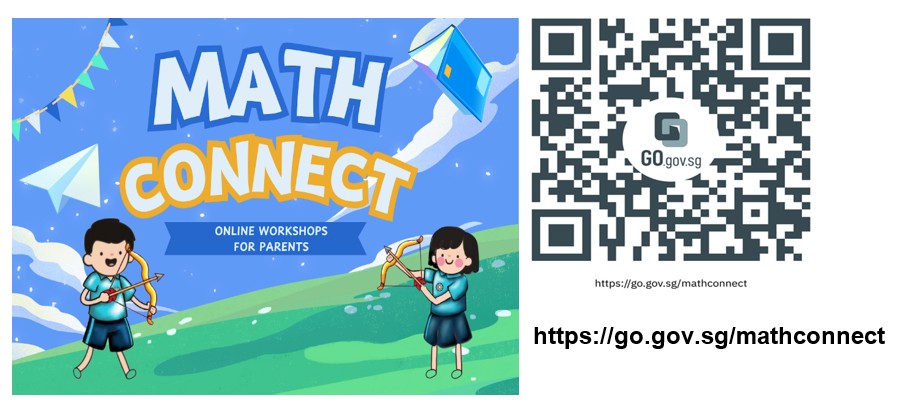
Math Connect – Parent Workshop
Our Math Connect is designed to build a strong and collaborative partnership between school and home, recognising that parents play a vital role in their children’s learning journey. Through this workshop, we aim to deepen parental involvement by equipping parents with practical tools and insights. By fostering meaningful engagement and providing focused resources, we seek to reinforce mathematical learning beyond the classroom and create a consistent, supportive environment that empowers every child to succeed in mathematics.
EdTech (Koobits and SLS)
Educational Technology (EdTech) is thoughtfully integrated into Mathematics lessons to enrich learning experiences, deepen conceptual understanding, and support personalised learning. Through interactive digital tools, students actively engage with mathematical concepts, receive timely feedback, and monitor their own learning progress. To foster self-directed learning, all Primary 1 to 6 students are provided access to KooBits, a Mathematics learning portal that encourages independent learning with minimal teacher supervision. In addition, the school works closely with parents to promote the use of the Student Learning Space (SLS) Adaptive Learning System (ALS), which provides personalised learning pathways tailored to each student’s strengths and learning needs.
STEAM Playground: Mathematics in Action
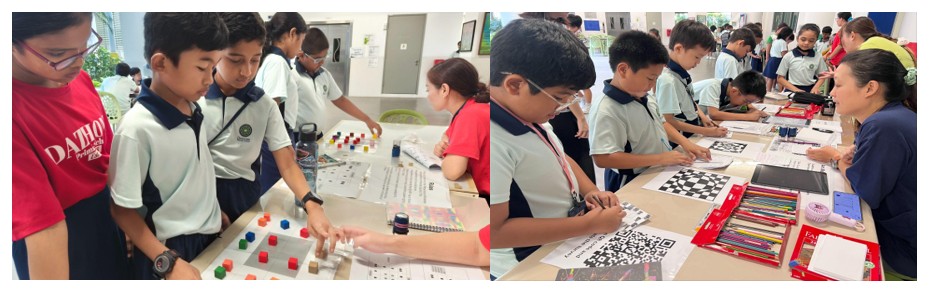
Our students enjoyed an exciting STEAM Playground experience held across all three recesses. Through a range of engaging activities, they had the opportunity to see how Mathematics connects with other disciplines while developing their problem-solving, reasoning and creativity skills.
At the Mathematics booth, students took on the Triangle Hunt Challenge, where they carefully counted hidden triangles of increasing complexity. As they progressed through the levels, they discovered patterns and explored the concept of triangular numbers, applying logical thinking and perseverance to solve each puzzle.
Students also experienced how Mathematics can be found in music. At the Music booth, they solved mathematical equations to determine notes and played familiar tunes on resonator bars, demonstrating the link between numbers, patterns and rhythm.
Beyond Mathematics, students engaged in activities that highlighted the interdisciplinary nature of STEAM learning. They learnt about measuring food waste and sustainability through sharing their experiences caring for Black Soldier Fly Larvae (BSFL), while the Art booth challenged them to use spatial reasoning and visualisation skills to complete symmetrical tangram designs.
The STEAM Playground provided meaningful opportunities for students to apply mathematical concepts in authentic and enjoyable ways. Through hands-on exploration and collaborative learning, students deepened their understanding of Mathematics while discovering its relevance in everyday life. We look forward to creating more exciting learning experiences that inspire curiosity and a love for learning.
Stretch Programmes
E2K Mathematics Programme:
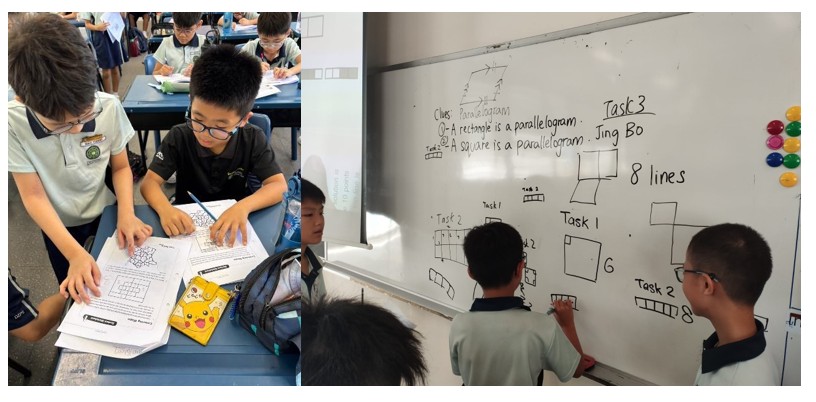
Selected Primary 4 to Primary 6 students participate in the MOE E2K Mathematics Programme, which aims to develop students’ mathematical thinking skills and deepen their conceptual understanding through an inquiry approach. Students will have opportunities to work independently or collaborate with their peers and engage in mathematical thinking through resources such as puzzles, games and mathematical explorations. The rich learning experiences offered by the programme will help students develop the habits, attitudes and dispositions mathematicians possess. Students will also gain important 21st Century Competencies such as Critical and Inventive Thinking and effective communication skills.
Mathematics Competitions:
Selected Primary 4 to Primary 6 students are invited to participate in Mathematics competitions, gaining exposure to intellectually challenging Mathematics questions that stretches their inner potential in the subject. Our students have participated in the following competitions:
- Asia Pacific Mathematical Olympiad for Primary Schools (APMOPS)
- Raffles Mathematical Olympiad (RMO)
- National Mathematical Olympiad of Singapore (NMO∑)
- River Valley High School Science, Technology, Engineering and Mathematics Festival (RV STEM Fest)
- Primary Mathematics Project Competition (PMPC)
Support Programme
LSM:
The Learning Support for Mathematics (LSM) programme is designed to provide early intervention support in mathematics to our students who may need additional support in acquiring basic numeracy skills when they enter Primary 1 and will continue, if deem necessary, in Primary 2 to Primary 4. There is an emphasis on ensuring that students have the necessary prerequisites before learning a new topic, hands-on learning with manipulatives, and reasoning and communication in the learning of mathematics.